The Impact of Early Screen Time on the Developing Brain
Screen time in the early years shapes how the brain wires itself for attention, language, self-regulation, and relationships, so "how much" and "what kind" of screen use matters far more than many adults realize. For infants, toddlers, and preschoolers, rich, back-and-forth human interaction ("serve and return") is the core driver of healthy brain architecture, and excessive or unsupervised screen time can crowd out those experiences when children need them most.
How early screen time affects the developing brain
In the first years of life, the brain rapidly strengthens the neural pathways that are used most often, pruning away those that are not. High levels of passive screen exposure have been linked to delays in communication, problem-solving, fine motor skills, and social skills, as well as later difficulties with attention and executive functioning. Large cohort and NIH imaging studies show that young children who spend more time on screens tend to score lower on language and thinking tests, and very high daily use has been associated with thinning of the cortex in areas tied to critical thinking and reasoning.
When supporting students with trauma, autism, and ADHD, this early wiring matters because these children are already more vulnerable to differences in attention, sensory processing, and self-regulation. Overstimulating visual input without matching real-world relational experiences can amplify sensory seeking or avoidance, reduce frustration tolerance, and make later classroom expectations (listening, waiting, flexible thinking) even harder.
The Evidence on Screen Time and Early Brain Development
In the digital age, screens are deeply woven into children's lives. From video chats with family to apps meant to educate, screens can play a role in how young people engage with the world. But when it comes to early brain development, especially for our most vulnerable learners — those impacted by trauma, neurodiversity (e.g., autism, ADHD), and lagging social-emotional or behavioral skills — we must ground our decisions in science.
1. Associations with Language and Cognitive Outcomes
Studies indicate that passive screen viewing in young children can reduce opportunities for rich back-and-forth interactions that support language and executive skills. Screen time may displace time spent engaging in dialogic play, conversation, and exploration — activities that are foundational to learning. Children and Screens
2. Links to Attention and Self-Regulation
Longitudinal evidence suggests that higher screen exposure in early childhood is associated with increased symptoms of autism and ADHD, as well as lower developmental achievement scores in preschool-age samples. Children who later exhibit elevated autism or ADHD symptoms also tended to have more screen exposure early in life. PubMed+1
Although these relationships do not confirm causation (i.e., screen time causes neurodevelopmental disorders), screen use patterns often differ for children with neurodiversity and reflect developmental vulnerabilities that can be amplified by certain types of media exposure. PubMed
3. Broad Behavioral and Health Connections
Across childhood and adolescence, excessive screen time — especially when unstructured — has been linked to increased ADHD symptoms, internalizing behaviors, sleep disturbances, and decreased physical activity. arXiv
Serve and Return in the Digital Era
Serve and return describes the back-and-forth exchanges where a child "serves" by looking, babbling, pointing, or acting, and an adult "returns" with warm, contingent responses—labeling, imitating, elaborating, and taking turns. These micro-interactions build neural circuits for language, stress regulation, and social understanding, and are strongly associated with better long-term learning, behavior, and mental health.
When screens replace these moments—especially for very young or highly vulnerable children—the brain gets fewer opportunities to practice reading cues, tolerating frustration, and regulating arousal with another human. Co-viewing and talking about what is on the screen can turn some media into a serve-and-return opportunity, but passive, solo viewing does not offer the same brain-building benefits.
As educators and specialists working with young children and families, reinforcing "serve and return"— especially for students with trauma histories or neurodiversity — is critical.
Video Resource: How Every Child Can Thrive by Five | Molly Wright | TED
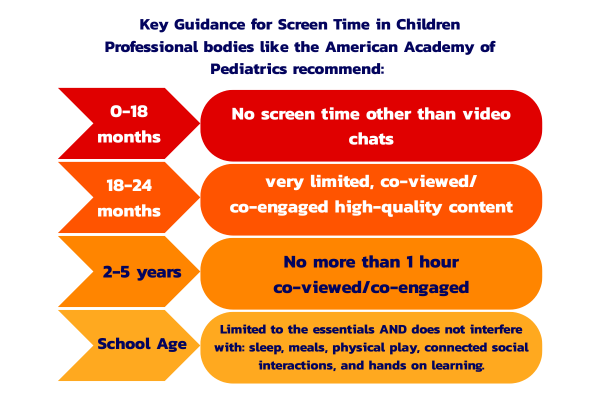
Guidance for Caregivers and Teachers
- Protect "screen-free, relationship-rich" routines (meals, car rides, bath, bedtime, transitions).
- Prioritize co-viewing over solo viewing, turning content into conversation, movement, and play.
- Watch for dysregulation patterns (e.g., big behaviors after fast-paced, high-intensity content) and adjust content, timing, and duration accordingly.
- Model shared reading, play, and conversation instead of defaulting to screens for quiet.
- Use structured coaching tools (e.g., Vroom, Early Head Start responsive interaction strategies) to support caregiver coaching. AAP
Conclusion: Striking a Developmentally Informed Balance
Screens are part of modern life, but the impact of screen time — both in quantity and quality — matters deeply for early brain development. For children with trauma histories or neurodiverse profiles, ensuring that screens do not replace critical human interaction is paramount.
By emphasizing serve-and-return interactions, limiting passive screen exposure, and guiding caregivers toward enriching activities that build communication and regulation skills, educators can help create environments where all children thrive.
Practical Tools and Resources
Videos
📌 Serve & Return and Early Development
📌 Parent & Professional Tools


 March 24, 2025
Leave a Comment