The Power of Positive Reinforcement
When was the last time someone complimented you? Really, truly acknowledged something great you did? And more importantly, when was the last time you did that for someone else?
If you're struggling to remember, you're not alone. And if you're reading this in mid-January, I need you to pay especially close attention. Because right now, in this exact moment, there's a collision happening in every classroom, every office, and every team across the country. And understanding it might just transform how you lead.
The Tolerance Cliff
Let me paint you a picture. Imagine a graph. On one side, we have tolerance for the people around us. On the other, our understanding of those same people. At the start of any school year, any project, any new relationship, we have incredibly high tolerance. Those quirky habits? Kind of endearing. That colleague who always tells the same story? Sort of charming, actually.
But here's what happens. As time passes, our tolerance drops while our understanding grows. We collect data points. We form narratives. We make judgments. And somewhere around mid-January in schools (or the midpoint of any long project), those two lines collide.
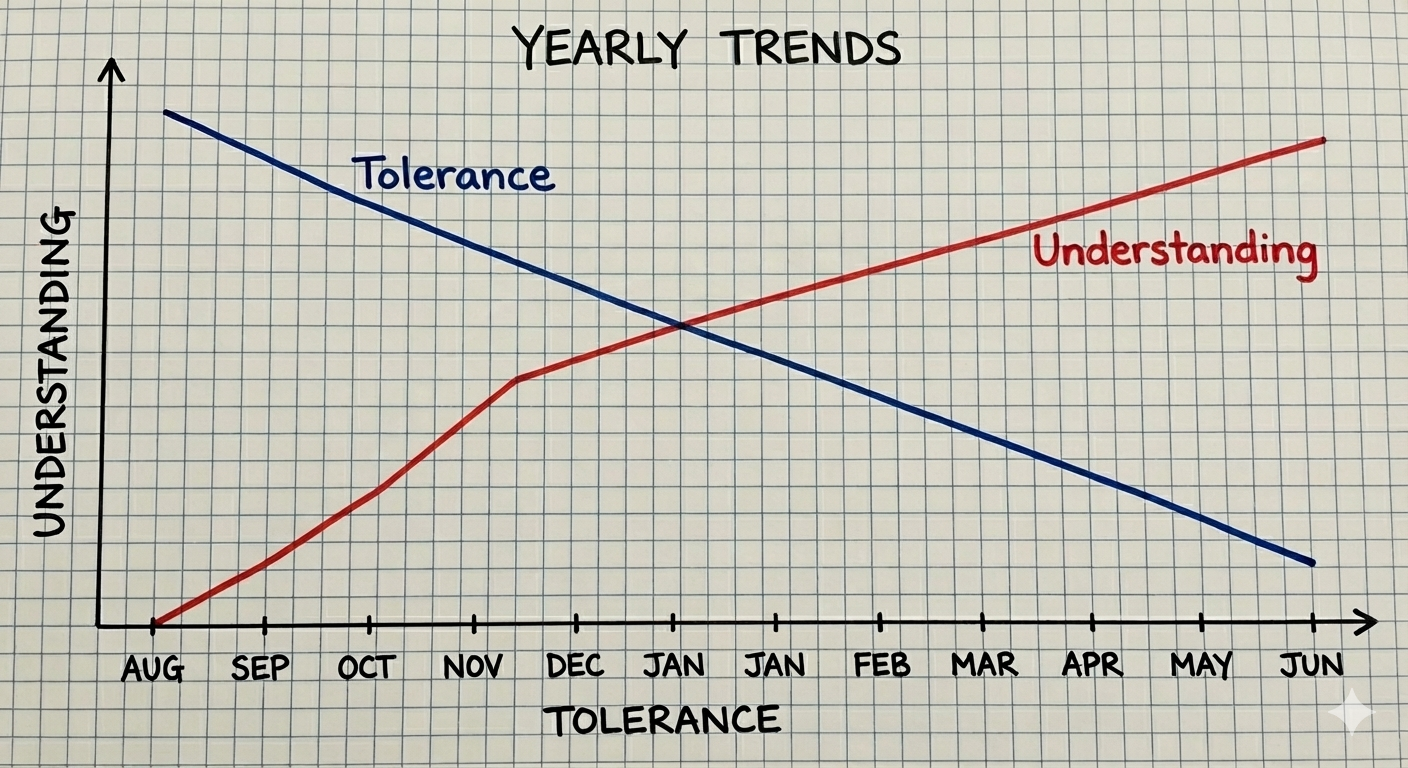
I learned this the hard way as a middle school principal. I started noticing a pattern. Behavioral referrals would spike. Team conflicts would escalate. The teacher's lounge would transform from a place of collaboration to a minefield of eye rolls and heavy sighs. One year, I walked into a team meeting with my usual enthusiasm and shouted, "Woohoo! Here we go, friends! Wednesday afternoon! Let's do this!" A veteran teacher I deeply respected glared at me and said, "Ted, it's getting old."
I walked straight to the men's room, stunned. A moment later, Jack, one of my mentors, came in and said, "Hey, Neitzke, it's that time of year. Nobody likes each other. Keep your head low, and once you get to spring break, people will return to normal."
That was months away.
Finding the Pattern
Years later, as a principal, I became obsessed with understanding this phenomenon. I pulled data, charted referrals, observed teams. And I discovered something fascinating. Not all teams experienced this collision. Some sailed right through January with grace and energy.
What made them different?
Four things stood out. First, these teams were candid and forgiving with each other. They lived by a simple motto: every day is a new day and deserves a fresh start. Second, they were relentlessly optimistic, finding lessons in failure and laughing through challenges. Third, they never gave up on a kid. If one teacher hit their limit, another would step in with fresh eyes and renewed patience. And fourth, they led with positive intent and positive reinforcement.
That last one? That's where the magic happened.
The Hallway Intervention
One team had this brilliant strategy. At their weekly meetings, instead of complaining about difficult students, they'd identify who needed a lift that week. Then they'd all commit to catching that student doing something right. But here's the genius part.
When one teacher caught the moment, they wouldn't just give a quick "good job" and move on. They'd call another teacher's classroom mid-lesson. The teacher having the conflict with that student would step into the hallway. And right there, in front of the kid, these two teachers would have an enthusiastic conversation about what they'd just witnessed.
"Hey, I need to tell you what I just saw Connor do in my classroom! He picked up someone else's papers and helped them out. Isn't this kid the best? He's seriously the best!"
They'd talk about Connor like he wasn't even there. Then they'd turn to him, affirm what they'd seen, and send him back to class. Thirty to sixty seconds. That's all it took. Connor got elevated. The teachers repaired their relationship with him. Everyone's tolerance went up.
This is the power of intentional positive reinforcement.
The Reinforcement Cliff
Here's something that will break your heart. Research shows that positive reinforcement is abundant in infancy and drops off a cliff as we age. When a baby is born, every single thing they do is celebrated. They smile? We lose our minds. They roll over? Call the grandparents! They eat peas? Film it for posterity!
In early childhood, we're still going strong. Sticker charts, high fives, enthusiastic praise for knowing the alphabet or zipping up a jacket. But by middle childhood, reinforcement becomes moderate and outcome-oriented. By adolescence, it's low and selective, coming primarily from peers and social media rather than the adults in their lives. And by adulthood? It's basically extinct.
We've created what researchers call a "parental praise cliff" during the teenage years. Just when young people are navigating identity formation and seeking autonomy, we stop telling them the good we see in them. No wonder they turn to social media for validation. They're thirsting for something we stopped providing.
The Five-to-One Ratio
Psychology research has identified a gold standard for relationships: the five-to-one ratio. Five positive interactions for every negative one. This benchmark predicts thriving relationships, whether in marriage, parenting, or the workplace.
But here's what I want you to really hear. Most of us have flipped that ratio, especially with teenagers and in the workplace during challenging seasons. We're firing off five criticisms for every one affirmation. We're focused on compliance rather than celebration. We're pointing out what's wrong instead of amplifying what's right.
If you're a teacher, start listening to yourself in the classroom. Are you five-to-one? If you're a parent, pay attention to your words in the car, at home, on the sidelines. Are you five-to-one? If you're a colleague, track your interactions. Are you five-to-one?
I've asked myself these questions, and honestly, the answers humbled me.
Becoming a Positive Magnet
Social media thrives because we're all magnetically attracted to places where we're needed, wanted, or admired. But here's the truth: social media has no soul. You do. So make yourself a magnet for others.
Here's how:
Practice intentional affirmations. With middle and high school students, this can be as simple as noticing them. "I like that t-shirt. Did you get new shoes? I appreciate how you always have your desk ready to go." Catch them in the minutiae of doing things well.
Point out qualities to higher-ups. Use the overheard compliment strategy. Talk to someone's boss about what they did well, making sure they can hear it. Or bring another person in to witness something excellent: "Hey, come here. I want to show you what Jerry does that's really cool."
Bring energy to every room. Be almost theatrical when you enter. Your energy sets the tone. When you bring positivity, you get positivity back.
Focus on micro, not macro, as people age. A quiet "it means a lot to me when you were kind in that moment" to a teenager means infinitely more than public praise at an assembly.
Make it personal and informal. Call students' parents on the spot to share good news. Send notes to colleagues' spouses or the parents of your staff members. Break the formality. Make it fun.
Your Charge This Week
I grew up with two grandmothers, Ginny and Helen, who unknowingly both did the same thing for me. As a young person navigating middle school and dealing with trauma, I constantly found myself at their houses. Ginny was quick with compliments and candor. She'd remind me of my areas for growth while fueling me with affirmations of my strengths. Helen would listen to everything happening in my life, then share stories of her own challenges and explain how I was better positioned to overcome mine.
I'd arrive at their houses negatively charged and leave positively charged. Fueled. Ready.
We are all negatively charged, looking for the positively charged person to stick to. That's your opportunity.
Be the one positively charged person in every environment. Look for the ways people are contributing in small and big ways. If you're a leader, think about how to lift the adults you support through positivity. If you're a colleague, be the teammate who brings energy. If you're a teacher, bring it to parents and kids.
What we model is what we get.
You control the bar graph. Increase your tolerance this month by looking for the positive. Choose to shoot for five-to-one with everyone you interact with. Believe that others are capable of changing. But remember: those changes only occur when you rise to the occasion by focusing on the good, letting people know what they are, and reinforcing it consistently.
That's how we give people the courage to be their best selves and inspire them to do the same for others.
So go ahead. List your tactics for reinforcing the positives you see in others. Describe areas where you need to grow in seeing the good in people. Identify those in your life who need to know the good they bring to this world.
And then tell them.
Because we need more obnoxiously optimistic people in the world. People who see the bright side, shout out when they see others being positive and impactful, and look for ways to be better for others.
The journey is long and winding, but you provide the energy to get through it. You're the positively charged force that others are seeking. Be that magnet. Charge into the challenge. Support others through the collision of tolerance and understanding.
That's your leadership moment. And it starts right now.


 March 24, 2025
Leave a Comment